 Professional
 Experienced
 Trusted

The 4 Hidden Things Most Homeowners Miss.... and why you're different
You have a running list in your head.
Furnace. Gutters. That weird noise the water heater makes. The filter that’s probably overdue. The crack in the basement wall you noticed last spring. The smoke detector that chirped once at 3 AM two weeks ago and hasn’t done it since—but you’re still listening for it.
Nobody asked you to track these things. Nobody thanks you for remembering. But if you didn’t? Everyone would notice.
This is the invisible mental load of keeping a home running. And if you’re reading this in early December while everyone else is focused on holiday shopping and party planning, you’re probably wondering which of those things actually needs attention before winter really hits.
Let’s talk about the furnace specifically—because unlike the gutters or that mystery chirp, this one has a deadline attached to it.
The Things You Can't See (And Why That Matters)

Here’s the uncomfortable truth about furnace failures: Most of them give you zero warning.
You’re listening for sounds. You’re paying attention. You’re being responsible. And none of that will tell you when the capacitor is about to fail, when the heat exchanger has developed a hairline crack, or when the flame sensor has just enough buildup to work today but not tomorrow.
The stuff that takes your furnace down in the middle of January? It’s happening silently right now.
Capacitors are the #1 failure point in furnaces, and they give almost no warning before they quit. They’re the electrical component that helps your blower motor start up. When they fail, your furnace just… stops. No heat. No warning. They can test perfectly fine one day and be completely dead the next. A technician can test them with a multimeter and tell you “this is at 65% of its rated capacity—it’s going to fail, probably this winter.” Without that multimeter? No way to know.

Heat exchangers develop cracks over time from the repeated heating and cooling cycles. Tiny cracks. Micro-fractures you absolutely cannot see without taking the furnace apart. These cracks let combustion gases—including carbon monoxide—mix with the air that goes into your house. Your furnace will run fine. You won’t hear anything wrong. This is why the heat exchanger inspection is the most important part of any tune-up.

Flame sensors get a coating of residue over time that prevents them from detecting the flame properly. Your furnace will start, fail to sense the flame, and shut down as a safety measure. This happens at 6 AM when it’s 5°F outside and you just want to get your kids ready for school.

Gas pressure can drift over time—usually slowly enough that you don’t notice the furnace running a little less efficiently. Too much pressure damages components and creates safety risks. Too little pressure means you’re paying to run a furnace that’s not heating efficiently. Either way, there’s no way to tell without the right measurement tools.
The point isn’t to scare you. The point is this: “Keeping an eye on it” has real limits.
You can listen. You can watch for performance changes. You can be as attentive as humanly possible. But the components that fail most often do it invisibly, and the only way to catch them early is with the right tools and expertise.
That’s what makes December different from January. In December, you’re looking. In January, you’re reacting.
Why December Is Actually Different (Besides Availability)
Everyone talks about how HVAC companies are less busy in winter, which is true. But there’s a more important reason December matters for your furnace specifically.
Right now, your furnace is warmed up but not stressed.
Think about it: You’ve been running heat since October. The system’s been through its startup phase. Any immediate failures already happened. But you haven’t hit the deep cold yet—those stretches where the furnace runs almost continuously for days.
This is your diagnostic sweet spot.

A technician can run your system through its full cycle without making your house uncomfortable. They can watch it operate under normal conditions. They can catch the early warnings—the “this will be a problem in six weeks” stuff that’s impossible to see during an emergency call in January when they’re just trying to get your heat back.
Plus, here’s something most people don’t think about: Your furnace works harder in January than in December. Not just longer hours—actual harder work. When it’s -10°F outside versus 25°F, your furnace has to make up a much bigger temperature difference. That extra stress exposes weak points.
Finding out you have a failing blower motor capacitor in December means you schedule a repair. Finding out in January means you’re sleeping in your living room with a space heater while you wait three days for an available tech.
What Actually Happens During a Professional Tune-Up
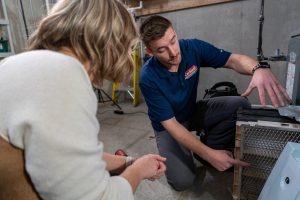
Let’s demystify this, because “inspection” is vague and it’s hard to know what you’re actually getting.
A real furnace tune-up isn’t just someone looking at your furnace and saying “yep, looks good.” Here’s what actually happens:
The stuff that keeps you safe:
- Heat exchanger inspection for cracks (this is the carbon monoxide concern—cracks let combustion gases into your air supply)
- Gas pressure testing (too high can damage components, too low means inefficient heating)
- Flame sensor and ignition system check (dirty sensors cause those startup delays you’ve been hearing)
- Carbon monoxide testing in your living space
- All safety switches verified
The stuff that prevents midnight breakdowns:
- Blower motor amp draw tested (tells you if the motor’s working too hard and about to fail)
- Capacitor tested with a meter, not just visually (capacitors are the #1 failure point)
- All electrical connections checked and tightened
- Thermostat calibration verified (yes, thermostats lie)
- Condensate drain cleaned (frozen drains trigger emergency shutdowns)
The stuff that saves you money:
- Burners cleaned (dirty burners waste gas and create soot)
- Air filter checked (running a clogged filter costs you roughly 15% more on your heating bill)
- Airflow measured (restricted airflow makes your furnace work harder and die younger)
The technician should also tell you what they found. Not just “everything’s fine” but actual information: “Your heat exchanger looks good, your ignition system is strong, but your capacitor is testing at the low end of acceptable range—keep an eye on it, you’ll probably need to replace it next season.”
That’s useful information. That goes on your mental list with actual context instead of just ambient worry.
DIY vs. When to Call the Pros
Here’s what you can and should do yourself:
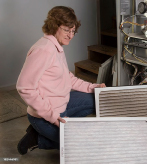
Check your air filter. Right now. I’ll wait.
If it’s grey or you can’t see light through it, replace it. This alone solves about 30% of “my furnace isn’t working right” calls. A clogged filter makes your blower motor work harder, restricts airflow, can cause overheating shutdowns, and costs you money. Filters are cheap. New blower motors are expensive.

Look at your thermostat.
Is it level? Is it in direct sunlight? Is it near a heat source like a lamp? All of these things affect accuracy. If your thermostat thinks it’s 72° but your living room is 68°, that’s a four-degree comfort problem that has nothing to do with your furnace.
Listen to your furnace while it runs a complete cycle.
Stand near it. Does it ignite smoothly? Does the blower kick on within a minute? Does it run steadily? Does it shut down cleanly? You’re not diagnosing problems here—you’re establishing a baseline. When something changes, you’ll actually know what changed.
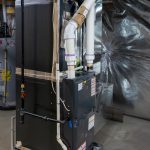
Clear the area around your furnace.
Seriously, take five minutes and move the holiday decorations, paint cans, and stored stuff away from it. Furnaces need airflow. Also, if something does go wrong, you want clear access.
Here’s what you shouldn’t DIY:
Anything involving gas lines, electrical components, or the inside of the furnace cabinet. The money you save is not worth the risk of gas leaks, electrical fires, or inadvertently breaking something that’ll cost three times as much to fix.
“YouTube University” has limits. Professional HVAC techs have diagnostic tools—manometers for gas pressure, multimeters for electrical testing, combustion analyzers for efficiency. They can tell the difference between “this is normal” and “this will fail in three weeks.” That kind of diagnostic precision just isn’t available without the right equipment, and that’s okay.
The Real Cost-Benefit Math
Let’s be practical about this.
A tune-up costs roughly $150-200. An emergency repair call in January starts at $300-400 before they even diagnose the problem. A full blower motor replacement runs $400-800. A heat exchanger? You’re looking at $1,500-2,500, and at that point, most people just replace the whole furnace.
But here’s the more important math: What’s your time worth?
Taking two hours off work in December to be home for a scheduled appointment versus taking a full day (or two) off in January when your furnace dies and you’re coordinating emergency repairs, maybe a hotel stay if it’s bitterly cold, definitely some family stress.
What’s your peace of mind worth? The difference between “I know my furnace is solid” and “I’m listening to that sound every time it kicks on and googling ‘furnace noises’ at midnight.”
We’re not trying to convince you either way. You know your situation. You know your furnace age, your risk tolerance, your budget, your stress capacity.
But if you’re carrying it on your mental list—if you’re noticing sounds, if you’re wondering “will it make it,” if you’re reading articles like this one—you’ve already decided. You’re just looking for permission to spend the money and the validation that it’s the smart call.
Consider this your permission: It’s the smart call.