
 Professional
 Experienced
 Trusted
Every house has a few things nobody wrote down.
A finished basement. An addition. A kitchen remodel. A new outlet added somewhere along the way. Maybe a weekend project from an owner who lived there 15 years before you did.
The walls get patched. The rooms get painted. The house changes hands.
And eventually, you inherit all of it.
Most of the time, an electrical outlet gives you very little reason to think about what’s behind it. You plug something in. It works. You move on.
But here’s the problem:
A correctly wired outlet and an incorrectly wired outlet can look exactly the same from the outside.
Looking fine isn’t the same as being wired right.
And unless the electrical system has actually been tested, you may simply be trusting decisions that were made years before you owned the house.
That doesn’t mean something is wrong.
It means looking at an outlet can’t tell you whether everything is right.
Testing can.
Why “It Works” Doesn’t Tell You the Whole Story
Plug in the coffee maker. It turns on.
Plug in a lamp. The bulb lights.
It’s easy to assume that means the outlet is wired correctly.
But whether an outlet supplies power and whether its wiring is correct are two different questions.
That distinction can be especially relevant in established Wisconsin homes that have changed over the years. A home may have been remodeled, expanded, updated, or worked on by different people at different times.
Nobody has to be the villain in that story.
The real issue is simpler: you weren’t there.
You don’t know what decisions were made, what was changed, or what was checked afterward.
Hope isn’t a wiring plan.
A real test replaces the assumption with information.

What Does a Wiring Health Check Actually Test?
What Does a Wiring Health Check Actually Test?
This is where the difference between looking and testing becomes important.
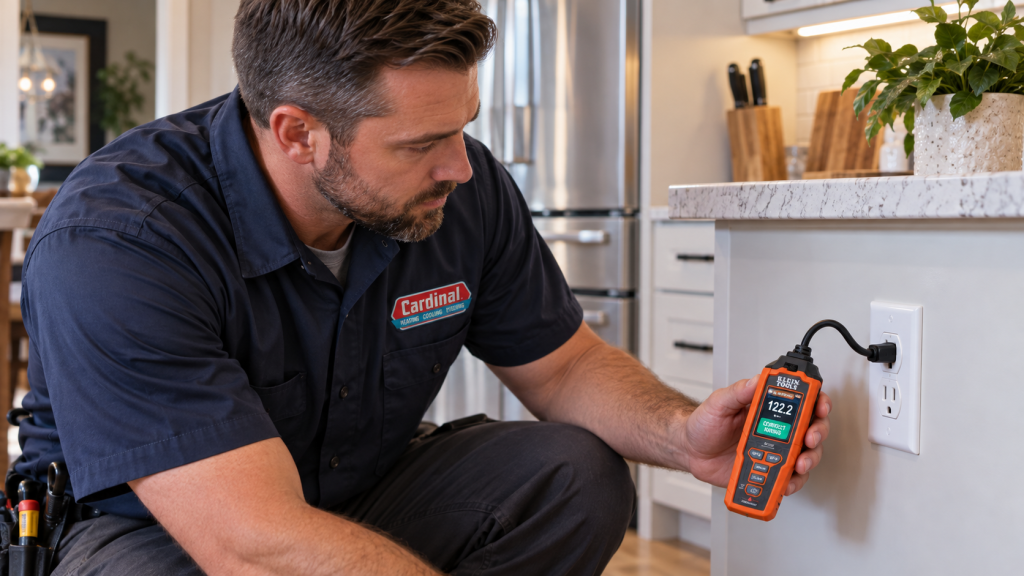
Cardinal’s Receptacle & Wiring Health Check isn’t simply a visual walkthrough. A technician uses diagnostic equipment to test accessible receptacles and take actual measurements.
The health check focuses on three areas: receptacle wiring, GFCI and AFCI protection, and voltage drop under load.
Receptacle Wiring
A receptacle can look completely normal from the room while testing reveals a wiring condition that isn’t visible from the outside.
Cardinal tests accessible receptacles for correct wiring, including conditions such as:
- Open ground
- Open neutral
- Open hot
- Reversed connections
That’s an important distinction.
The technician isn’t looking at the outlet and deciding it “seems fine.”
It gets tested.
GFCI and AFCI Protection
You’ve probably seen outlets with TEST and RESET buttons, particularly in areas such as kitchens, bathrooms, garages, and other locations where GFCI protection may be used.
GFCIs are designed to respond to ground faults or leakage current by quickly interrupting power.
AFCI protection may be less familiar to homeowners. AFCIs are designed to detect certain hazardous electrical arcing conditions and interrupt the circuit.
During Cardinal’s health check, GFCI and AFCI protection is tested using actual trip time and trip current readings.
In plain English, the goal isn’t simply to see that a device exists.
It’s to test how the protection actually responds.
Voltage Drop Under Load
An outlet can provide power and still leave another question unanswered:
What happens when it actually has to do some work?
Cardinal checks voltage drop under an actual load as part of the diagnostic.
That gives the technician another measured piece of information about the receptacle rather than relying on appearance alone.
And that’s really the theme of the entire check.
Measure. Don’t guess.
What a Wiring Health Check Does Not Do
This distinction matters just as much as explaining what gets tested.
A receptacle tester does not see through walls.
It does not scan your entire electrical system from a single outlet. And a wiring health check should not be described as finding every possible electrical problem in a home.
Cardinal tests the accessible receptacles the technician can reach, along with the GFCI/AFCI protection and voltage-drop measurements included in the check.
That scope makes the answer more useful, not less.
You know what was tested.
You know what was measured.
And you know what the results actually tell you.

Why Older and Remodeled Homes Can Leave Questions Behind
Walk through a house that has been lived in for 20 or 30 years and you can often see its history.
Maybe one room has newer trim.
Maybe the basement was finished later.
Maybe an addition changed the original floor plan.
Maybe there’s an outlet somewhere that makes you wonder, When did that get added?
Those changes don’t automatically mean anything was done incorrectly.
They simply mean your home’s electrical system may contain decisions you didn’t make and work you never saw happen.
That’s particularly relevant for homeowners in Wisconsin living in established homes that have been updated over time.
You inherited the finished house.
You didn’t inherit the story behind every wire.
Testing gives you a way to learn more about what you actually have.
What Happens After the Testing?
There are two outcomes, and both are useful.
The first is simple: the testing confirms that what was checked is operating as expected.
That’s an answer.
The second is that testing identifies something that deserves further attention.
That’s an answer, too.
The point of testing isn’t to go looking for reasons to worry. It’s to replace an assumption with information so you can make a better decision about your home.
You don’t have to know everything about electrical wiring.
You just need a way to stop guessing.

Wiring Health Check FAQs
Can You Tell if an Outlet Is Wired Correctly Just by Looking at It?
No. The appearance of an outlet alone doesn’t verify that it is wired correctly. Testing the receptacle provides information that isn’t visible from the outside.
Does a Wiring Health Check See Inside My Walls?
No. Cardinal’s check tests accessible receptacles using diagnostic equipment. It should not be confused with technology that scans through walls or an evaluation that claims to identify every possible electrical issue in the home.
What Does Cardinal Test?
The Receptacle & Wiring Health Check includes testing accessible receptacles for correct wiring, including open ground, open neutral, open hot, and reversed connections.
Cardinal also tests GFCI and AFCI protection using trip time and trip current readings and checks voltage drop under load.
Know. Don’t Guess.
You don’t need to assume the wiring decisions you inherited were right.
And you don’t need to assume they were wrong.
You can test them.
Through November 6, 2026, Cardinal Heating, Cooling, Plumbing & Electric is offering its Receptacle & Wiring Health Check free, with no obligation to book additional work.
Cardinal has more than 4,500 five-star Google reviews and has served roughly 60,000 homeowners in Dane County.
Get a real reading on your home’s wiring, at no cost.