 Professional
 Experienced
 Trusted

Your Home Has Been Holding Its Breath Since November
You know the feeling. The first genuinely warm morning of May, you open the back door and step outside, and there it is: that breath. Clean, open, like the season itself finally showed up after months of waiting.
Then you step back inside.
It’s not the same. There’s a heaviness to it. A smell that’s hard to name but impossible to ignore once you notice it, like the house has been holding its breath since November and just hasn’t let go yet. You throw open a few windows, light a candle, tell yourself it’ll air out.
It does, a little. But it comes back.
Here’s why that happens, and what Cardinal can do about it.
Why Indoor Air Quality Gets Worse in Winter (And What Changes in Spring)
Wisconsin winters do something to a home that most people don’t think about until spring makes the contrast obvious. From roughly October through April, your house is sealed. The windows stay closed. The furnace runs. And every time it does, air moves through the system and back out into your living space, carrying with it whatever has settled into the ductwork, the filters, and the air handler over the course of the season.
Dust circulates. Odors accumulate. Organic buildup develops in places nobody ever looks. By May, the air your family has been breathing every day since fall has been making the same loop through the same system for six months without a real reset.
You don’t notice it gradually. You notice it the moment you step outside and feel the contrast.
What's in Your Home's Air After a Wisconsin Winter
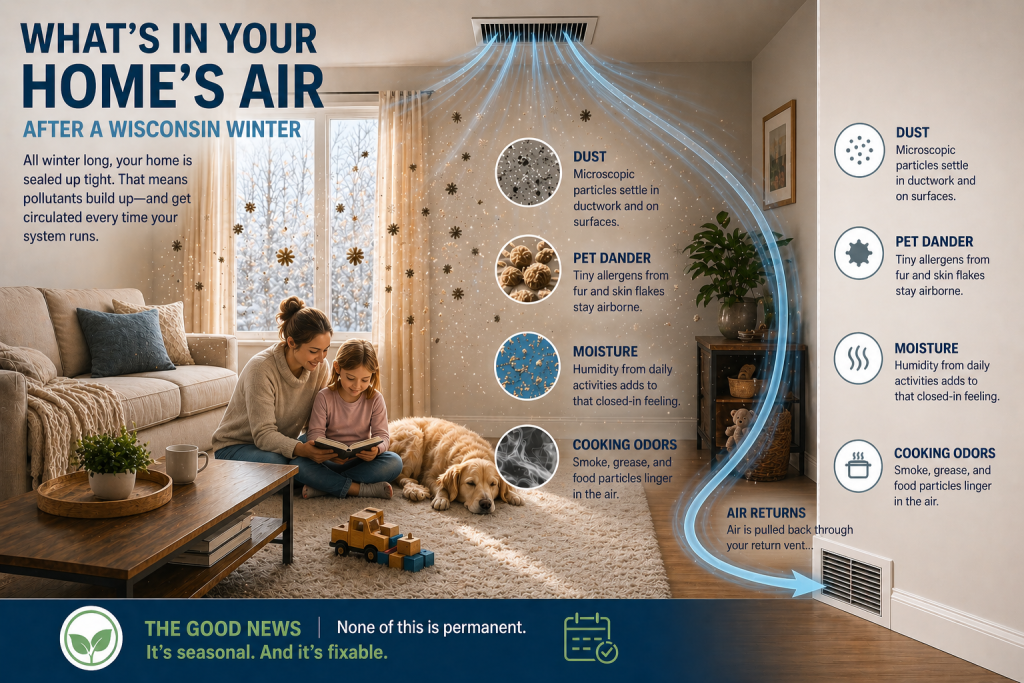
This isn’t meant to alarm anyone. But it’s worth being honest about what a sealed winter home accumulates.
Dust particles too small to see settle into ductwork and get redistributed every time the system runs. Pet dander, cooking odors, and moisture all contribute to that closed-in smell that clings to a house after a long winter. And for families with kids who’ve had stuffy noses or restless nights since January, the air inside the home is often a bigger factor than the season itself.
The good news is that none of this is permanent. It’s seasonal. And it’s fixable in a single appointment.
Wildfire Smoke and Indoor Air Quality: What Dane County Homeowners Should Know
A couple of summers ago, Dane County homeowners closed their windows against haze drifting down from Canadian wildfires and wondered whether it was getting in anyway. In many cases, it was. Smoke particles are small enough to infiltrate through gaps, vents, and standard filtration systems, and they linger.
Homes with IAQ treatment handled it differently. The particles were addressed before they could circulate freely through the living space, and air quality inside stayed meaningfully better than in untreated homes.
If the smoke returns this summer, the homeowners who act in May will be in a much better position than the ones who wait. That’s not manufactured urgency. It’s just how these seasons have been going in Wisconsin.

What You Can Do to Improve Indoor Air This Spring
If your home’s air has felt heavier or harder to breathe lately, there are a few practical ways to address it.
- Replace or upgrade your air filter
A clogged or low-quality filter allows dust and particles to circulate. A higher-efficiency filter can make a noticeable difference.
- Consider duct cleaning
After a full Wisconsin winter, buildup inside ductwork can contribute to that closed-in smell. Cleaning the system removes what’s been circulating for months.
- Add whole-home air treatment
Systems like air cleaners, UV lights, or ionizers work inside your HVAC system to reduce particles, odors, and contaminants before they reach your living space.
- Address airflow and moisture
Stale air is often a circulation issue. Improving airflow or balancing humidity can help your home feel fresher without relying on open windows.
Most of these solutions are straightforward. The key is knowing which one actually applies to your home.
Most homeowners wait until spring to think about indoor air, and by then they’ve already spent five or six months breathing whatever accumulated over the winter. The better move is getting ahead of it so the air inside your home stays fresh year round, not just when it’s warm enough to crack the windows. That’s the difference between reacting to how the air feels and just never having to think about it.
Common Indoor Air Quality Questions from Dane County Homeowners

Why does my house smell stale in spring?
After months of being sealed up during winter, dust, odors, and airborne particles build up and recirculate through your HVAC system. When warmer weather arrives, the contrast with fresh outdoor air makes it more noticeable.
Does duct cleaning really help with indoor air quality?
In many homes, yes. If there is visible buildup in the ductwork, cleaning it can reduce circulating dust and improve how the air feels and smells throughout the home.
What is the best way to improve indoor air quality?
It depends on the home. For some, a better filter is enough. For others, duct cleaning or a whole-home air treatment system makes a bigger impact. The best solution is based on how your system is set up and what’s built up over time.
Are whole-home air purifiers worth it?
They can be, especially for households dealing with allergies, dust, or seasonal air quality issues like wildfire smoke. These systems work continuously within your HVAC system to improve air before it circulates.
Can wildfire smoke get inside my home?
Yes. Smoke particles are small enough to enter through small gaps and standard filtration systems. Homes with upgraded filtration or air treatment systems are better equipped to handle it.